Why leadership teams must move beyond transformation activity and learn to measure organizational capability, operating performance, and enterprise value.
The Transformation Paradox
Imagine sitting in a board meeting where management reports that the enterprise transformation is on schedule. The technology has been deployed. Employees have completed their training. The new operating model has been announced. The transformation office has checked off its milestones. The dashboard is predominantly green.
There is just one problem: revenue productivity has not materially improved, operating friction remains, and customers are not experiencing a fundamentally different business.
So what, exactly, has transformed?
I have spent more than two decades working alongside leadership teams, scaling organizations, advising investors, and participating in strategic and operating decisions. One recurring observation stands out: organizations can become extraordinarily proficient at managing transformation activity while losing sight of the reason transformation was necessary in the first place.
I’m Sam Palazzolo. I work with CEOs, boards, and investors on one fundamental question: How do we scale the organization and maximize enterprise value? Sometimes that means working alongside a leadership team, sometimes participating as a BoD member, and increasingly, teaching those same principles at NYU.
The uncomfortable question is not whether an organization can execute a transformation plan. It is whether that transformation is making the organization more valuable. The distinction matters. In this article, I examine why conventional transformation metrics can create a false sense of progress and introduce five disciplines for converting organizational learning into measurable enterprise value.
The Measurement Trap: Activity Is Not Transformation
Most transformation programs begin with good intentions. Leadership identifies a strategic imperative, establishes a vision, allocates capital, appoints program leaders, and develops an implementation road map. Progress is subsequently measured through milestones, budgets, adoption rates, and project completion.
These measures are not inherently wrong. They are simply insufficient.
A technology deployment does not necessarily create a competitive advantage. Employee training does not guarantee behavioral change. A redesigned operating model does not automatically improve productivity. And completing 90% of a transformation program does not mean the organization has captured 90% of its anticipated value.
Kaganer and Loch (2026), writing in Harvard Business Review, make a compelling case for treating transformation as a learning journey rather than a fixed project. Their research highlights how rigid transformation programs can discourage adaptation, suppress operational insights, and create organizational fatigue.
The implication is significant: transformation should be evaluated not only by what the organization delivers, but by what it learns, what capabilities it develops, and what measurable business improvements follow.
James March’s (1991) research on exploration and exploitation reinforces this challenge. Organizations must balance discovering new opportunities with improving what they already know how to do. Overemphasizing either can undermine long-term performance.
The leadership challenge, therefore, is to create an operating system that continuously converts learning into action.
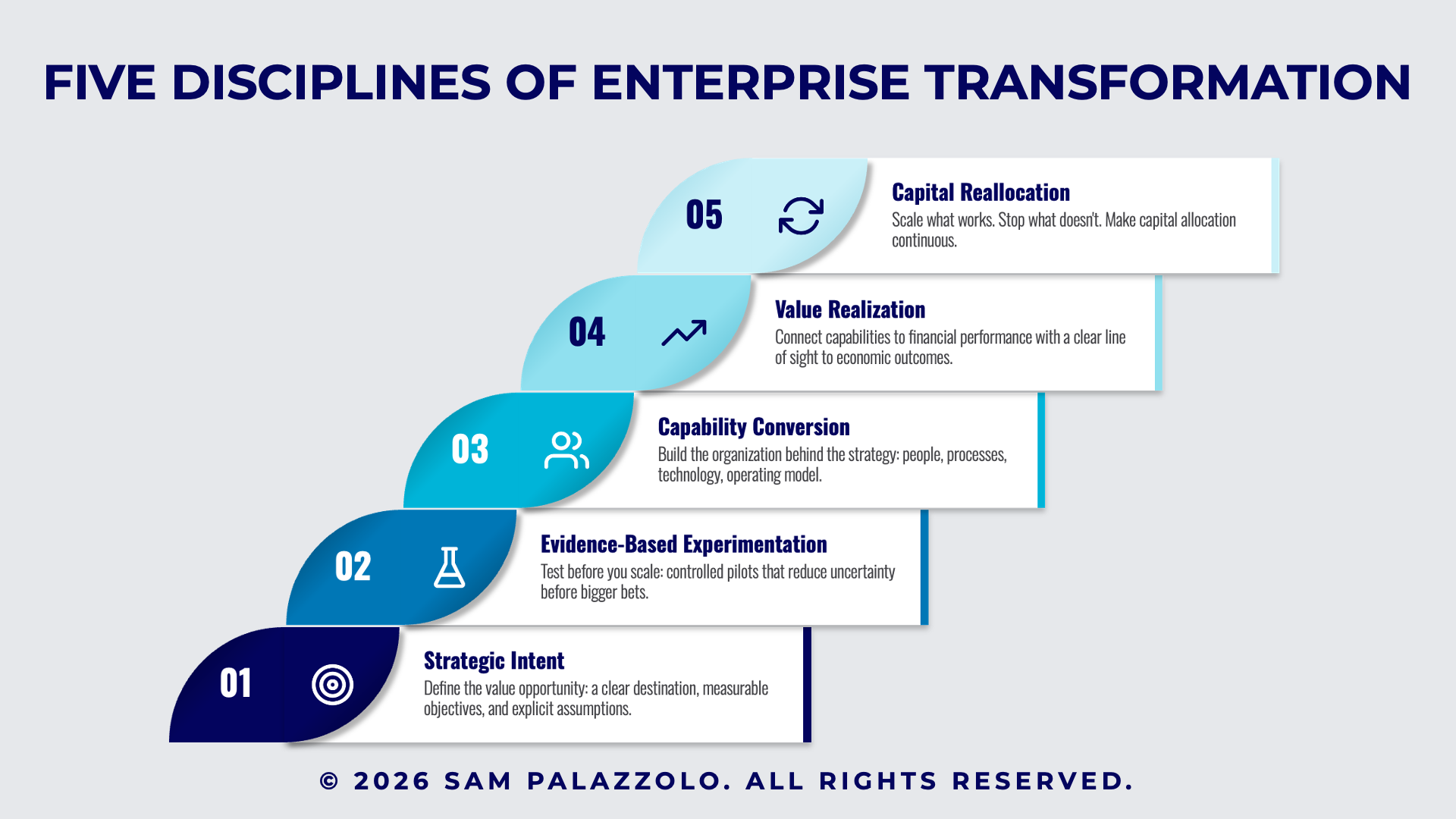
Five Disciplines of Enterprise Transformation
I propose five interconnected disciplines for managing transformation as an enterprise value creation process. These are not sequential project phases. They are management disciplines that must continually inform one another.
1. Strategic Intent: Define the Value Opportunity
Transformation requires a clear destination, but leaders should distinguish strategic intent from an inflexible implementation plan.
What are we actually trying to accomplish? Grow revenue? Improve margins? Increase customer lifetime value? Reduce operational complexity? Develop capabilities that create a defensible competitive advantage?
The answers establish the economic rationale for transformation.
A compelling strategic intent provides direction while leaving room for new information to change the route. Leaders should articulate the intended value creation, establish measurable objectives, and identify the assumptions that must prove true.
2. Evidence-Based Experimentation: Test Before You Scale
Too many organizations scale assumptions before validating them.
A new technology is deployed enterprise-wide before its commercial value is established. A new sales methodology is mandated before frontline adoption is understood. A new business model receives substantial capital before customer willingness to pay has been demonstrated.
Experimentation introduces discipline into strategic decision-making.
Rather than treating every initiative as an implementation commitment, leadership should establish controlled pilots that test critical assumptions, expose operational constraints, and generate evidence.
The objective is not to celebrate experimentation for its own sake. It is to reduce uncertainty before making larger commitments.
3. Capability Conversion: Build the Organization Behind the Strategy
A strategy is only as effective as the organization’s ability to execute it.
This is where many transformations encounter resistance. Leadership introduces new technologies, processes, and commercial expectations without adequately developing the capabilities required to support them.
Capability conversion requires deliberate investment in:
- People: Leadership effectiveness, workforce competencies, and behavioral change.
- Processes: Repeatable operating disciplines, accountability, and decision rights.
- Technology: Integrated systems, usable data, and scalable infrastructure.
- Operating models: Clear ownership, cross-functional coordination, and incentives aligned with strategic priorities.
Teece, Pisano, and Shuen (1997) describe dynamic capabilities as the organizational processes that enable firms to integrate, build, and reconfigure competencies in changing environments. The practical implication is straightforward: sustainable transformation requires more than acquiring new resources. It requires developing the organizational capacity to deploy them effectively.
That capacity also depends on whether employees can surface problems, challenge assumptions, and learn from failure without organizational penalty. Edmondson’s (1999) research on psychological safety and team learning reinforces the importance of creating those conditions.
4. Value Realization: Connect Capabilities to Financial Performance
This is where transformation moves from organizational activity to business performance.
New capabilities must ultimately translate into measurable improvements in revenue, margin, productivity, customer experience, or competitive positioning.
Consider the difference between measuring the deployment of an AI-enabled sales tool and measuring its impact on sales productivity, conversion rates, and revenue per representative. The first measures implementation. The second measures value.
Kaplan and Norton (1992) established the importance of balancing financial outcomes with the operational and organizational drivers of future performance. Transformation requires that same discipline.
Every major initiative should have an explicit line of sight between the investment, the capability being developed, the expected operational improvement, and the economic outcome.
5. Capital Reallocation: Scale What Works. Stop What Doesn’t.
Transformation is not a commitment to every initiative launched at its inception.
It is a commitment to achieving the strategic ambition.
As evidence accumulates, leadership must be prepared to increase investment in successful initiatives, modify those showing promise, and discontinue projects that no longer justify their resource requirements.
This requires something many leadership teams find uncomfortable: the willingness to acknowledge that an earlier decision was wrong.
It also requires organizational influence and alignment. Jeffrey Pfeffer’s work on organizational power and influence reminds leaders that sound ideas do not implement themselves. Change requires the ability to build coalitions, secure resources, navigate competing interests, and translate decisions into organizational action.
Capital allocation should be continuous, not simply an annual budgeting exercise.
The Boardroom Test: LEGO’s Transformation
Consider the transformation of The LEGO Group.
By 2003–2004, LEGO was approaching an existential crisis. Sales had declined approximately 30% in 2003, and the company reported a DKK 1.8 billion loss in 2004. Debt had reached approximately DKK 5 billion. Its innovation efforts had expanded into businesses and products that frequently failed to generate sustainable returns (Foss et al., 2012; Kenyon-Rouvinez et al., 2014).
Under CEO Jørgen Vig Knudstorp, LEGO undertook a fundamental turnaround. The company simplified its business, refocused on core products and customers, improved operating discipline, and restructured its innovation processes.
The lesson is not that innovation was abandoned. It was that innovation became more closely connected to customer demand, organizational capabilities, and commercial accountability.
LEGO returned to profitability in 2005 and achieved substantially stronger financial performance in subsequent years (Robertson & Crawford, 2008; Foss et al., 2012).
The transformation illustrates an important principle: enterprise value is not created by pursuing more initiatives. It is created by developing the organizational discipline to determine which initiatives deserve investment and how they contribute to the business.
For boards and investors, this raises five practical questions:
- What strategic assumptions are we testing?
- Which organizational capabilities are we developing?
- What measurable business improvements have emerged?
- Where are we realizing financial value?
- Which investments should we accelerate, redirect, or terminate?
These questions shift governance from reviewing transformation activity to evaluating transformation economics.
From Transformation Activity to Enterprise Value
Successful transformation requires more than strategic vision and execution discipline. It requires leaders who can recognize when assumptions are no longer valid, challenge organizational inertia, and redirect resources toward opportunities with demonstrated potential.
This connects directly to my October article, Harnessing Chaos Through Curiosity. Curiosity enables leaders to question assumptions and interpret uncertainty. Transformation is the organizational mechanism through which that learning becomes action.
The five disciplines provide a practical management architecture: establish strategic intent, experiment with evidence, convert insights into capabilities, realize measurable value, and continuously reallocate capital.
The distinction is consequential. Organizations should not confuse the completion of transformation initiatives with the achievement of transformation outcomes.
Enterprise transformation is not about completing a predetermined list of initiatives. It is about building an organization that can continuously convert strategic insight into operating performance and competitive advantage.
The ultimate measure is not how much transformation an organization has undertaken. It is how much more valuable the organization has become.
Sam Palazzolo
Operator. Investor. Educator. Enterprise Value Strategist.
Scaling organizations. Maximizing enterprise value.
References
Edmondson, A. (1999). Psychological safety and learning behavior in work teams. Administrative Science Quarterly, 44(2), 350–383. https://doi.org/10.2307/2666999
Foss, N. J., Pedersen, T., Pyndt, J., & Schultz, M. (2012). LEGO: Redefining the boundaries. In Innovating organization and management: New sources of competitive advantage (pp. 41–71). Cambridge University Press. https://doi.org/10.1017/CBO9780511820434.003
Kaganer, E., & Loch, C. (2026). Transformation should be a learning journey. Harvard Business Review, September–October, 54–63.
Kaplan, R. S., & Norton, D. P. (1992). The balanced scorecard: Measures that drive performance. Harvard Business Review, 70(1), 71–79.
Kenyon-Rouvinez, D. H., Glemser, A.-C., & Whiteley, P. (2014). The LEGO group: Family business resilience (A) (IMD-7-1622). IMD.
March, J. G. (1991). Exploration and exploitation in organizational learning. Organization Science, 2(1), 71–87. https://doi.org/10.1287/orsc.2.1.71
Robertson, D., & Crawford, R. J. (2008). Innovation at the LEGO group (A) (IMD-3-1978). IMD.
Teece, D. J., Pisano, G., & Shuen, A. (1997). Dynamic capabilities and strategic management. Strategic Management Journal, 18(7), 509–533. https://doi.org/10.1002/(SICI)1097-0266(199708)18:73.0.CO;2-Z